Performance Bottlenecks: How Outdated Software is Costing Your Business
The Hidden Cost of "Making Do" With Legacy Systems
In today's fast-paced business environment, your software infrastructure is either a competitive advantage or a significant liability. While it might seem practical to stick with the familiar legacy systems that have "worked well enough" for years, the reality is that outdated software creates costly performance bottlenecks that silently drain resources, frustrate employees, and ultimately damage your bottom line.
Many businesses don't realize just how much their aging systems are costing them until they've already lost significant time, money, and opportunities. According to recent industry research, companies spend an average of 60-80% of their IT budgets just maintaining legacy systems—resources that could otherwise fuel innovation and growth.
Let's examine how these performance bottlenecks manifest and calculate their true cost to your business.
The Productivity Tax: How Much Time Are Your Teams Wasting?
The most immediate impact of outdated software is the productivity drain it imposes on your workforce. Consider these common scenarios:
- Your employees regularly wait for screens to load or systems to respond
- Staff members develop manual workarounds for tasks that should be automated
- Teams spend hours reconciling data between systems that don't communicate
- IT personnel dedicate significant time to maintaining and troubleshooting outdated code
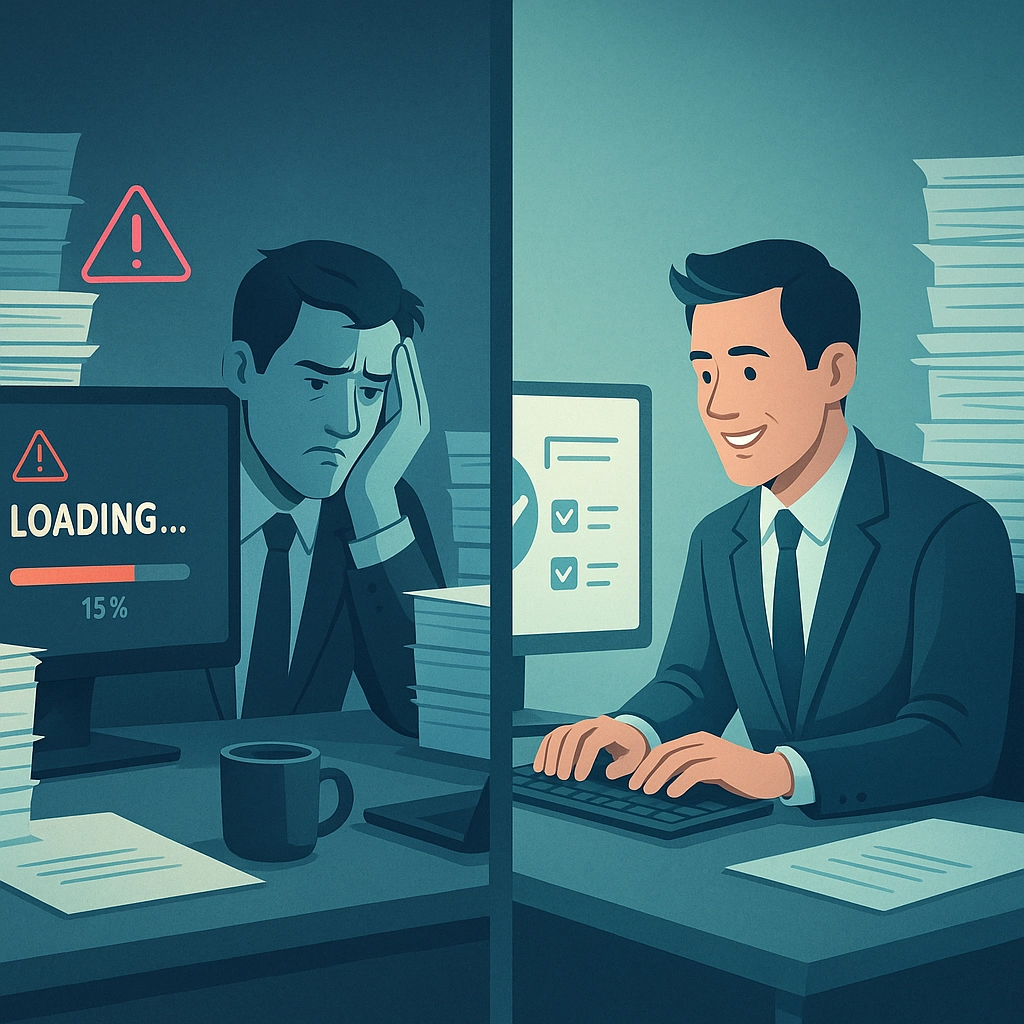
In a medium-sized company, these inefficiencies can easily cost each employee 5-10 hours per month in lost productivity. Multiply that across your organization, and the numbers become staggering. For a company with 100 employees at an average hourly cost of £30, that's £15,000-£30,000 in wasted salary expenses every month—without accounting for opportunity costs and missed deadlines.
One of our clients, a distribution company in the Midlands, discovered they were losing over 400 collective hours monthly due to their aging inventory management system. Staff regularly waited 45+ seconds for search results to load and frequently had to restart the application when processing large orders. After modernization, those same processes now complete in under 3 seconds, saving the company approximately £144,000 annually in reclaimed productivity.
The Snowballing Technical Debt
Technical debt—the implied cost of future rework caused by choosing expedient solutions now instead of better approaches that would take longer—compounds with outdated software. Like financial debt, it accrues interest in the form of:
-
Increasing maintenance costs: As systems age, finding qualified developers familiar with outdated technologies becomes more difficult and expensive.
-
Compatibility challenges: Legacy systems often struggle to integrate with modern tools, requiring costly custom connectors or middleware.
-
Security vulnerabilities: Outdated software frequently lacks security patches, creating significant exposure to modern threats.
-
Escalating hardware costs: Many legacy applications require specific hardware configurations that become increasingly expensive to maintain as components become obsolete.
This accumulating technical debt doesn't appear as a line item on your financial statements, but it's no less real. For many organizations, the total cost of maintaining legacy systems can exceed three times what a modern replacement would require.
The Customer Experience Penalty
Today's customers expect seamless, responsive digital experiences. When your internal software can't keep up, customer satisfaction inevitably suffers:
- Slow order processing creates fulfillment delays
- Customer service representatives can't access comprehensive information
- Errors in pricing, inventory, or shipping occur more frequently
- New features and services take too long to implement
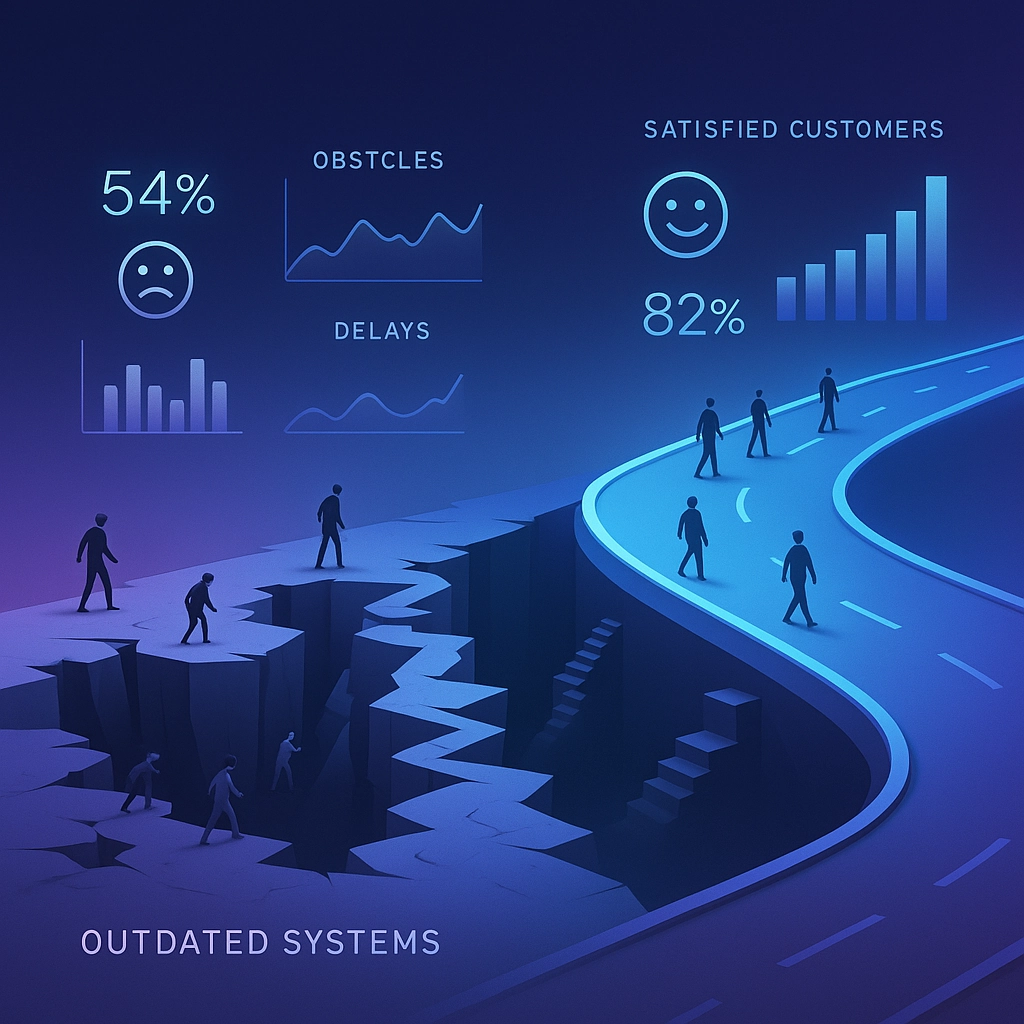
A financial services firm we worked with was losing clients specifically because their outdated CRM system couldn't provide the response times customers expected. Client onboarding took 3-5 days compared to competitors' same-day service. After modernizing their platform, they reduced onboarding to under 4 hours and saw a 32% increase in client retention.
The Innovation Barrier
Perhaps the most significant cost of performance bottlenecks is how they prevent businesses from evolving. When your IT team spends most of their time "keeping the lights on" with legacy systems, they have little capacity for strategic initiatives that could transform your business.
This creates a widening competitive gap as more agile competitors leverage modern technologies to:
- Implement data-driven decision making
- Automate routine processes
- Create new revenue streams through digital offerings
- Adapt quickly to market changes and opportunities
One manufacturing client described their legacy ERP system as "innovation quicksand"—the more they tried to build new capabilities, the more they sank into compatibility issues and performance problems. After modernizing their core systems, they successfully launched three new service offerings within 18 months, creating a 22% revenue increase.
The Real-World Impact: A Cost Analysis
Let's calculate the real impact of software performance bottlenecks for a typical mid-sized business:
| Cost Category | Monthly Impact | Annual Cost |
|---|---|---|
| Lost productivity (100 employees) | £22,500 | £270,000 |
| IT maintenance overhead | £8,500 | £102,000 |
| Customer churn from poor experience | £15,000 | £180,000 |
| Missed business opportunities | £12,000 | £144,000 |
| Total Cost | £58,000 | £696,000 |
This nearly £700,000 annual drain doesn't include less tangible costs like employee frustration, damaged reputation, or competitive disadvantage.
Breaking Free: The Modernization Advantage
Modernizing your critical business systems isn't merely a technical upgrade—it's a strategic investment with measurable returns. Organizations that successfully update their software infrastructure typically experience:
- 15-30% increase in overall productivity
- 40-60% reduction in IT maintenance costs
- 25-35% improvement in customer satisfaction metrics
- 20-40% faster time-to-market for new initiatives
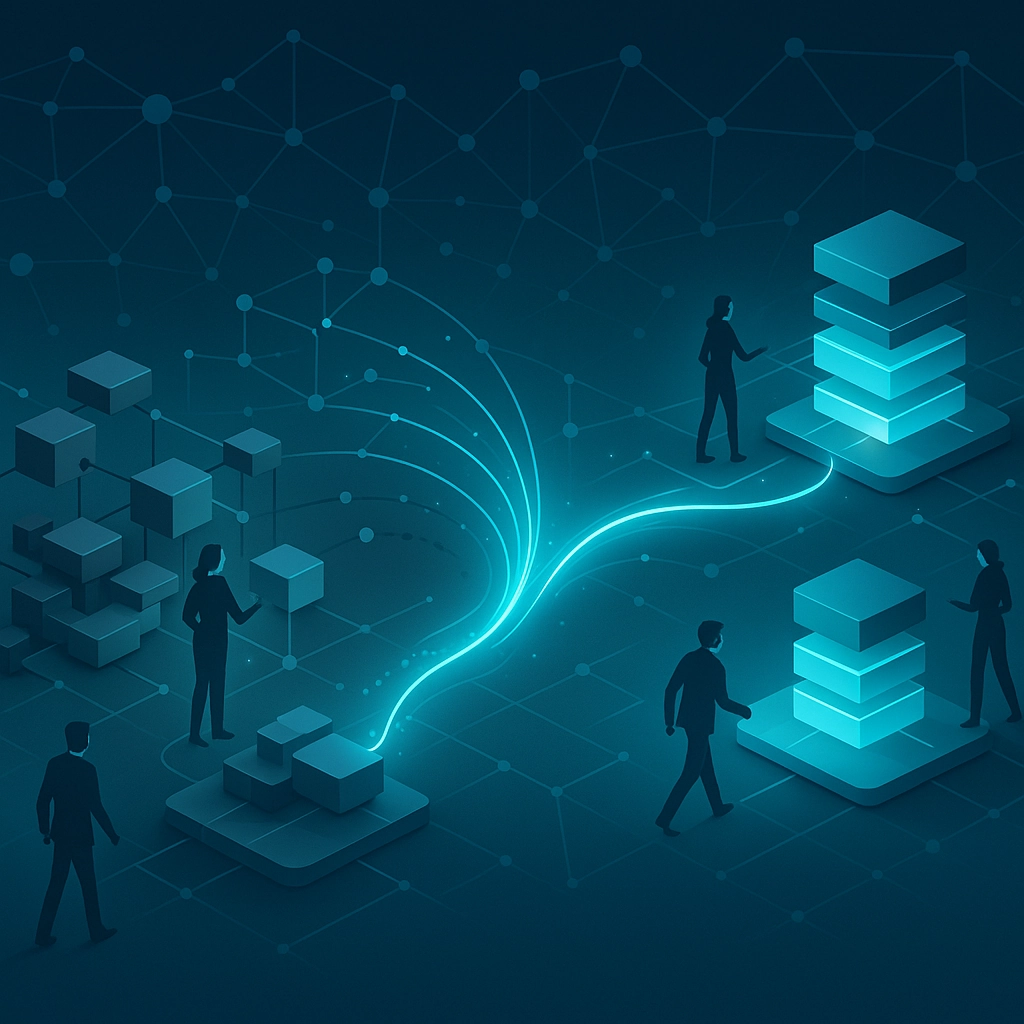
The key is approaching modernization strategically. At Wolf Software Systems, we've developed a proven four-step process to help businesses transform their legacy systems without disrupting operations:
-
Assessment and Mapping: We identify your most critical bottlenecks and map dependencies between systems to develop a prioritized modernization roadmap.
-
Strategic Architecture: Rather than simply recreating old systems with new technology, we design flexible architectures that support your business objectives today and tomorrow.
-
Phased Implementation: We modernize your systems incrementally, ensuring business continuity while progressively eliminating bottlenecks.
-
Knowledge Transfer: We ensure your team fully understands the new systems and can maximize their potential.
Case Study: From Bottleneck to Breakthrough
A professional services firm we partnered with was struggling with a 12-year-old practice management system that was creating significant bottlenecks. Report generation took hours, client data was siloed, and the system crashed regularly during peak usage periods.
Instead of a risky "rip and replace" approach, we implemented a phased modernization strategy:
- Phase 1: Performance optimization of the existing system reduced immediate pain points while planning proceeded
- Phase 2: Data migration to a modern, cloud-based architecture
- Phase 3: Incremental feature replacement with modern equivalents
- Phase 4: Full transition to the new platform with enhanced capabilities
The results were transformative:
- Report generation time reduced from hours to minutes
- System downtime eliminated
- Staff productivity increased by 27%
- Client satisfaction scores improved by 34%
Most importantly, the firm's technology became an enabler rather than an obstacle, allowing them to introduce new service offerings that increased revenue by 18% within the first year after completion.
Taking the First Step
Performance bottlenecks in outdated software aren't just IT problems—they're business problems that affect every aspect of your operation from employee satisfaction to customer experience and financial performance.
The good news is that modernization doesn't have to be disruptive or prohibitively expensive. With the right approach, you can systematically eliminate bottlenecks while introducing new capabilities that create competitive advantage.
At Wolf Software Systems, we specialize in helping businesses transform their critical systems with minimal disruption and maximum return on investment. Our team brings decades of experience in modernizing legacy applications across industries, with a focus on practical solutions that deliver measurable business outcomes.
Ready to eliminate the bottlenecks holding your business back? Contact our team today for a no-obligation assessment of your systems and discover how modern software can become your competitive advantage.