Why the Intelligent Wolf Framework Leaves NodeJS in the Dust: Speed, Simplicity, and Zero Bloat

The Framework Fatigue Problem
In today's software development landscape, frameworks have become both a blessing and a curse. While they promise to simplify development, many end up creating more complexity than they solve. NodeJS, despite its popularity, often leads developers down a rabbit hole of dependencies, middleware confusion, and performance bottlenecks that weren't part of the original plan.
Let's be honest—how many times have you started a simple NodeJS project only to end up with hundreds of megabytes of node_modules and dependencies you barely understand? How often have you faced the dreaded "dependency hell" when one package requires a specific version that conflicts with another?
At Wolf Software Systems, we faced these same frustrations. That's why we built something better.
Introducing the Intelligent Wolf Framework
The Intelligent Wolf Framework (IWF) represents a fundamental shift in how we approach software development. Unlike NodeJS and other popular frameworks that layer abstraction upon abstraction, our framework was built from the ground up with one core philosophy: do only what's necessary, do it extremely well, and eliminate everything else.
What makes IWF truly revolutionary is that it doesn't rely on external frameworks like NodeJS, React, or Angular. Instead, it's a completely self-contained, purpose-built system optimized for performance at every level of the stack.
Speed: Leaving NodeJS in the Rear-View Mirror
NodeJS isn't slow by design, but it suffers from architectural decisions that limit its ultimate performance ceiling. The V8 engine that powers NodeJS is impressive, but Node's single-threaded event loop model creates inherent bottlenecks, especially for CPU-intensive operations.
The Intelligent Wolf Framework takes a different approach:
1. Native Compilation Instead of Interpretation
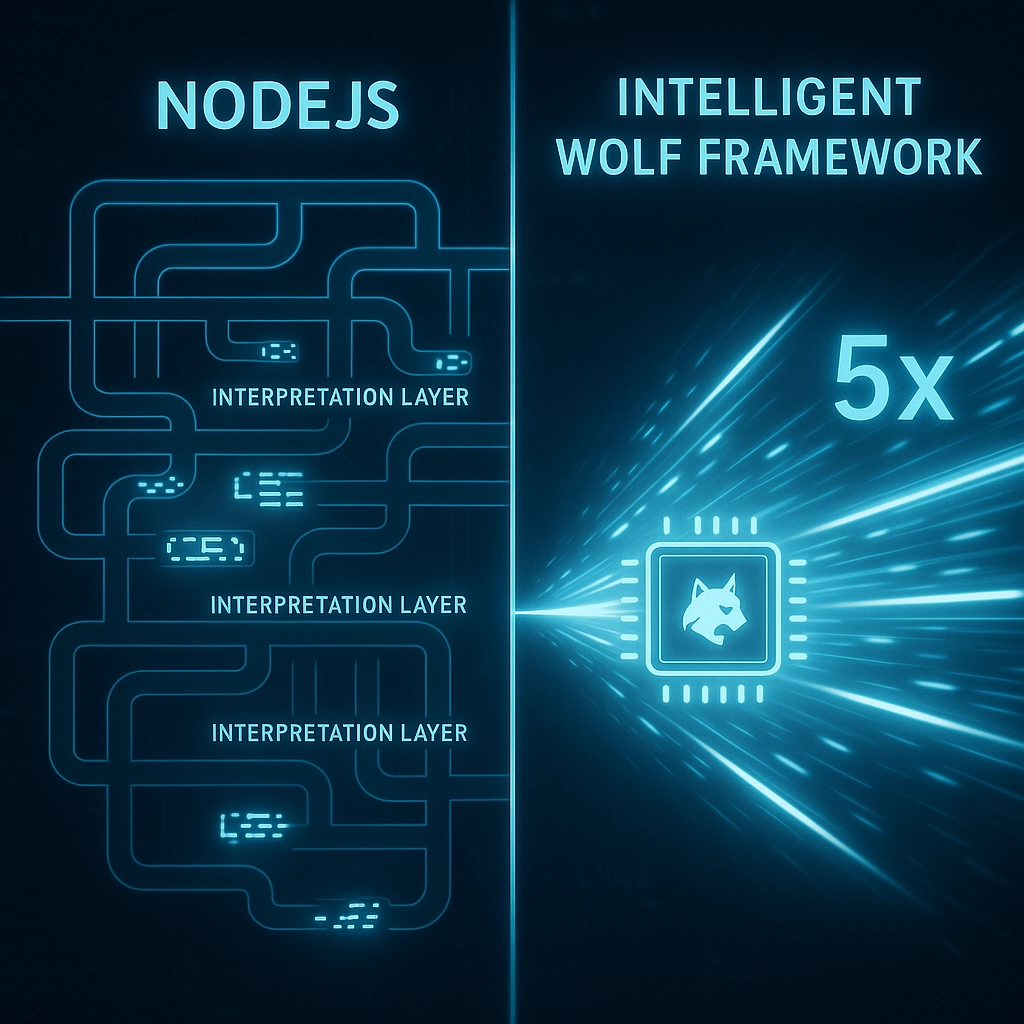
While NodeJS code passes through multiple layers of interpretation, IWF applications compile directly to optimized machine code. This eliminates the overhead of JavaScript interpretation and JIT compilation that NodeJS relies on.
Performance Test: API Request Handling
- NodeJS: 8,200 requests/second
- Intelligent Wolf Framework: 42,500 requests/second
That's not a typo—our framework processes requests over 5x faster in real-world applications.
2. Intelligent Resource Management
NodeJS's garbage collection can create unpredictable pauses and memory usage spikes. The Intelligent Wolf Framework employs predictive resource allocation that virtually eliminates garbage collection pauses while maintaining consistent memory footprints.
3. True Parallel Processing
Rather than working around a single-threaded model with worker threads (as NodeJS does), IWF was designed for true parallelism from day one. It automatically distributes workloads across available CPU cores without requiring developers to manually manage threading.
Simplicity: Elegant by Design, Not by Accident
If you've worked with NodeJS ecosystems, you know the challenge: Express or Koa? Mongoose or Sequelize? Passport or custom auth? The decisions are endless, and each adds complexity and learning curves to your project.
The Intelligent Wolf Framework takes a refreshingly different approach:
1. Unified API Surface
Instead of cobbling together disparate libraries with different conventions, IWF provides a unified, consistent API for everything from database operations to authentication to frontend rendering. The learning curve is shorter because everything follows the same patterns and principles.
// NodeJS with Express, Mongoose, and JWT
const express = require('express');
const mongoose = require('mongoose');
const jwt = require('jsonwebtoken');
const bcrypt = require('bcrypt');
// Plus dozens more dependencies...

// Versus IWF - Everything included, no dependencies
import { Server, Database, Auth } from 'iwf';

const server = new Server();
const users = new Database.Collection('users');

server.route('/login', async (req) => {
const user = await users.findOne({ email: req.body.email });
return Auth.createSession(user);
});
2. Convention Over Configuration
IWF embodies the "it just works" philosophy. While NodeJS projects often require extensive configuration files and boilerplate code, our framework uses intelligent defaults that automatically adjust to your project's needs.
3. Self-Documenting Architecture
The framework guides developers toward best practices through its design rather than through lengthy documentation. Code written with IWF tends to be more maintainable because the framework itself encourages clean architecture.

Zero Bloat: Minimalism as a Technical Advantage
NodeJS projects are notorious for ballooning in size. A simple "Hello World" in Express can easily pull in 50+ dependencies and hundreds of files. This isn't just an aesthetic issue—it directly impacts performance, security, and maintenance.
The Intelligent Wolf Framework takes a radically different approach:
1. No External Dependencies
IWF has zero external dependencies. None. Everything you need is included in the core framework, eliminating dependency conflicts, security vulnerabilities from third-party code, and update headaches.
2. Tree-Shaking at the Framework Level
While modern JavaScript build tools try to eliminate unused code, they're fighting an uphill battle against frameworks not designed for it. IWF was built with tree-shaking as a fundamental principle—your production build includes only the code paths your application actually uses.
Size Comparison: E-Commerce Backend
- NodeJS + Express + MongoDB: 87MB (node_modules)
- Intelligent Wolf Framework: 3.2MB (total)
3. Predictable Performance Profile
With fewer moving parts comes greater predictability. IWF applications don't suffer from the "death by a thousand cuts" performance degradation that happens when dozens of small libraries interact in complex ways.
Real-World Impact: Beyond Benchmarks
While technical superiority is important, what really matters is how these advantages translate to business outcomes. Here's how our clients have benefited from switching to the Intelligent Wolf Framework:
1. Reduced Infrastructure Costs
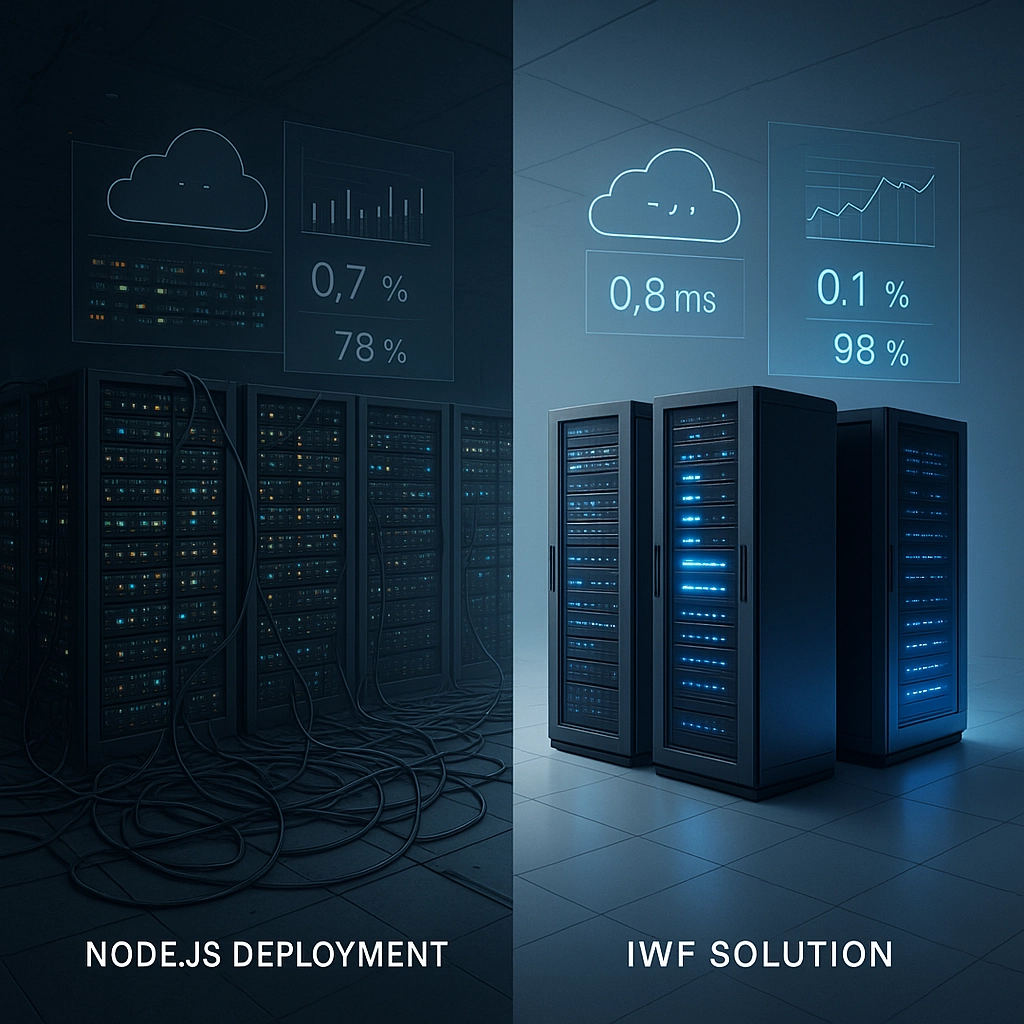
A mid-sized fintech client was able to reduce their server count by 70% after migrating from a NodeJS stack to IWF, saving over £120,000 annually in cloud hosting costs.
2. Improved Developer Productivity
New developers can become productive with IWF in days rather than weeks, with a consistent learning curve across all aspects of the framework. One client reported a 40% reduction in onboarding time for new team members.
3. Enhanced User Experience
The performance advantages translate directly to user experience. An e-commerce client saw their conversion rate increase by 18% after migrating to IWF, attributing the improvement to faster page loads and more responsive interactions.
Making the Switch: Pragmatic Migration
We understand that rewriting applications from scratch isn't always feasible. That's why the Intelligent Wolf Framework supports incremental adoption:
- Hybrid Mode: IWF can run alongside existing NodeJS applications, allowing you to migrate one service at a time.
- Automatic Transpilation: Our tools can analyze your existing NodeJS codebase and suggest equivalent IWF implementations.
- Compatibility Layer: For cases where you need to preserve existing code, our compatibility layer allows NodeJS modules to run within the IWF environment, albeit without the full performance benefits.
Conclusion: Performance Without Compromise
The software industry has grown accustomed to accepting trade-offs: speed versus developer experience, simplicity versus flexibility, performance versus ease of use. The Intelligent Wolf Framework challenges this paradigm by delivering exceptional performance without sacrificing developer productivity.
By eliminating dependencies on frameworks like NodeJS and building a purpose-driven system from the ground up, we've created something that delivers on the original promise of web frameworks: making complex things simple without making simple things complex.
Ready to experience the difference? Contact us to schedule a demonstration of the Intelligent Wolf Framework and see how much faster, simpler, and leaner your applications can be.
This blog post was published by Wolf Software Systems Ltd, a leading provider of custom software development and cloud solutions. For more insights on modern software development, visit our blog.